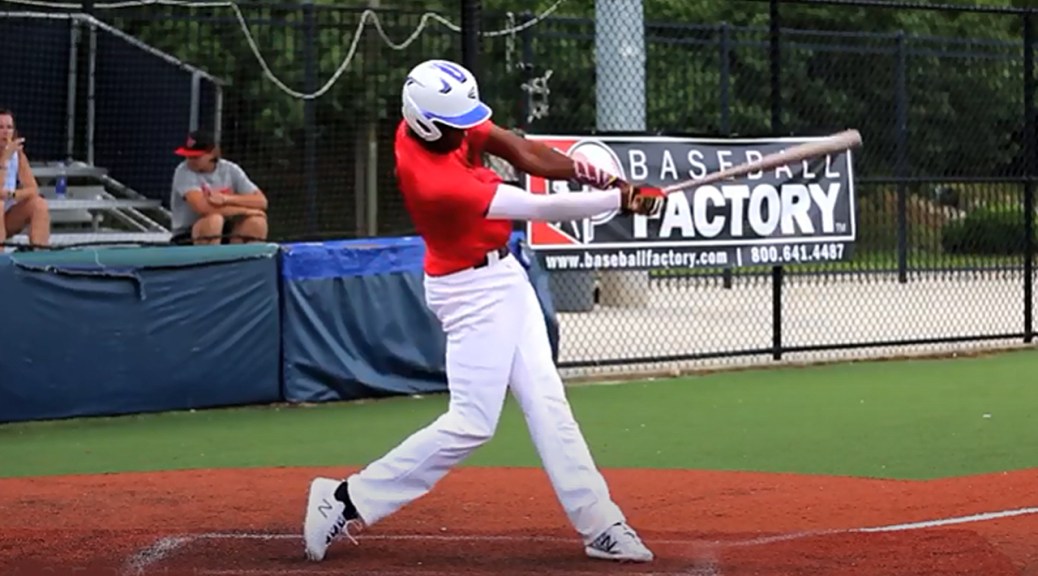
Cardinals fans, you might know Jordan Walker as the Redbirds’ newest first round draftee. As you may have heard during his announcement as the 21st selection in the 2020 Major League Baseball Entry Draft, the 18-year old hitter most recently manned third base for Decatur High School. While he has some experience as a pitcher, he has incredible potential at the plate. Signing for a $2.9 million bonus, Walker forwent a commitment to Duke University to ink his first contract in professional baseball. Here’s what you might not know.
Coming in at 6’5, 212 lbs., Walker’s frame is massive. He has considerable power potential, matching a considerable build with an incredibly smooth swing. While he is quite raw, it is impossible to watch him take cuts and not see flashes of greatness. Though he is a right-handed hitter, his swing is more reminiscent of that of a left-handed hitter; it displays easy power, the kind of easy power you can find in a swooping swing found more often on the right side of the plate, from lefty sluggers like David Justice, Will “the Thrill” Clark, or even (dare I say it) Ken Griffey Jr, leading to exit velocities measured in the triple digits (per Perfect Game). A swing this clean is far from commonplace in this game, and he partners it with the ability to get his hands inside with ease, giving him full command over the strike zone. Raw power grade: 70. That 70 is not a given. He has a tendency to flatten the bat out that needs some work, but swing inconsistency is his greatest flaw as a hitter. If he could plant the barrel on the ball more, he could unlock that rare 70 grade power, but it is much more likely that his potential game power hangs a tick lower than that. Game power potential: 60/65.
That does not, however, mean he is guaranteed any of the hundreds of home runs those stars parked in the stands. His hit tool is very, very far from pro ready, and could limit his power potential greatly, keeping him off the basepaths altogether. He simply does not consistently square up the ball in games like he does in batting practice. When he does, it is a thing of pure beauty, launching doubles and bombs to deep left field far beyond what is expected of a teenager. He needs to barrel the ball with far more regularity, as that is his biggest flaw as a hitter. He also has a swing that should lend to a high whiff rate, lending to a high K% and forcing more poor swings when backed into a corner on 0-2 or 1-2 pitchers’ counts. Current hit grade: 25, hit grade potential: 55.
His defense might be his most intriguing tool. He gets in front of the ball well, has decent range, and turns his hips to third well to make good use of an absolute cannon of an arm. If he were 6’2, I would say he’s a natural longterm fit at third base. However, the huge frame that makes his power his most impressive tool may end up acting as an anchor for his defense. Players of that size tend to have trouble at third, as no matter whether or not they have the instincts and reflexes to handle the hot corner, their bodies cannot often handle the movements demanded of the position, as reflected by his shuttle time of 5.15 seconds, compared to the high school class of 2020’s average of 4.89 seconds (per Perfect Game). His tools reflect the kind of third baseman teams seek out on the open market. His body, however, will move him to one of the other corner positions, either in the outfield or at first base. While his size is so optimal for a first baseman that you may be picturing him in a split already, I actually think his best fit may be in right field. It would give him the opportunity to use his aforementioned gun on throws into the diamond (more on that later), and use his speed (more on that later as well) to range around the outfield with ease. Fielding grade: 45, fielding potential: 55.
His arm is more than just that of a good third baseman. As I mentioned earlier, he spent some time on the mound as an amateur. His fastball reached the 90’s, recorded as high as 93 by Perfect Game. This arm translates to the diamond in a way that could be applicable either at third or in the outfield. He transfers the ball from his glove to his throwing arm well, but doesn’t pull back with his wrist as is customary, instead pulling back harshly with his right elbow before throwing at a 3/4 arm slot. He doesn’t struggle dropping his arm angle to make a quick throw on the run, making quality throws across the diamond consistently. His only arm concern is inaccuracy when forcing hard throws, a common issue at third base. Arm grade: 55 infield, 60 outfield.
Jordan Walker is not the lumbering, Hulkish slugger of yesteryear. He combines impressive power with impressive speed that a lot of equal hitters cannot match. His 6.56 60-yard dash, while not an exact reflection of game speed, shows a player that can beat out infield hits to the left side, steal bases at a high rate with a low number of attempts, and reach nearby fly balls with ease. He likely won’t be a 20/20 threat, but double digit stolen bases are not out of reach, and his gap power combining with this speed could make him quite the threat as a doubles hitter. As he fills out his 6’5 body, however, he should slow down some. Current speed grade: 60 potential speed grade: 55.
Any player with tools this loud has a legitimate chance at being a Major League All-Star. Any player with tools this loud that falls to 21 in the draft, has serious concerns. His major concerns are in the form of contact hitting and plate discipline. As of right now, he has to make massive leaps to stay north of the Mendoza line, and likely will spend his entire career suffering a high number of strikeouts. These limitations are more than enough to keep Walker, who should play a position where hitting is at a premium, from being a productive professional. Personally, I don’t think he’ll let these issues hold him back from being an everyday major leaguer, but they could stop him from being an All-Star.
Looking at all of the tools and limitations Jordan Walker boasts (or suffers from), from surprisingly present speed, to questionable contact consistency; from valuable defense at the corner positions, to massive raw power, he is reminiscent of pro baseball in 2020 in a lot of different ways. That said, I think his best (90th percentile) comp actually comes from baseball’s past. Pro player comparison: Frank Robinson.
 You Might Know Sports