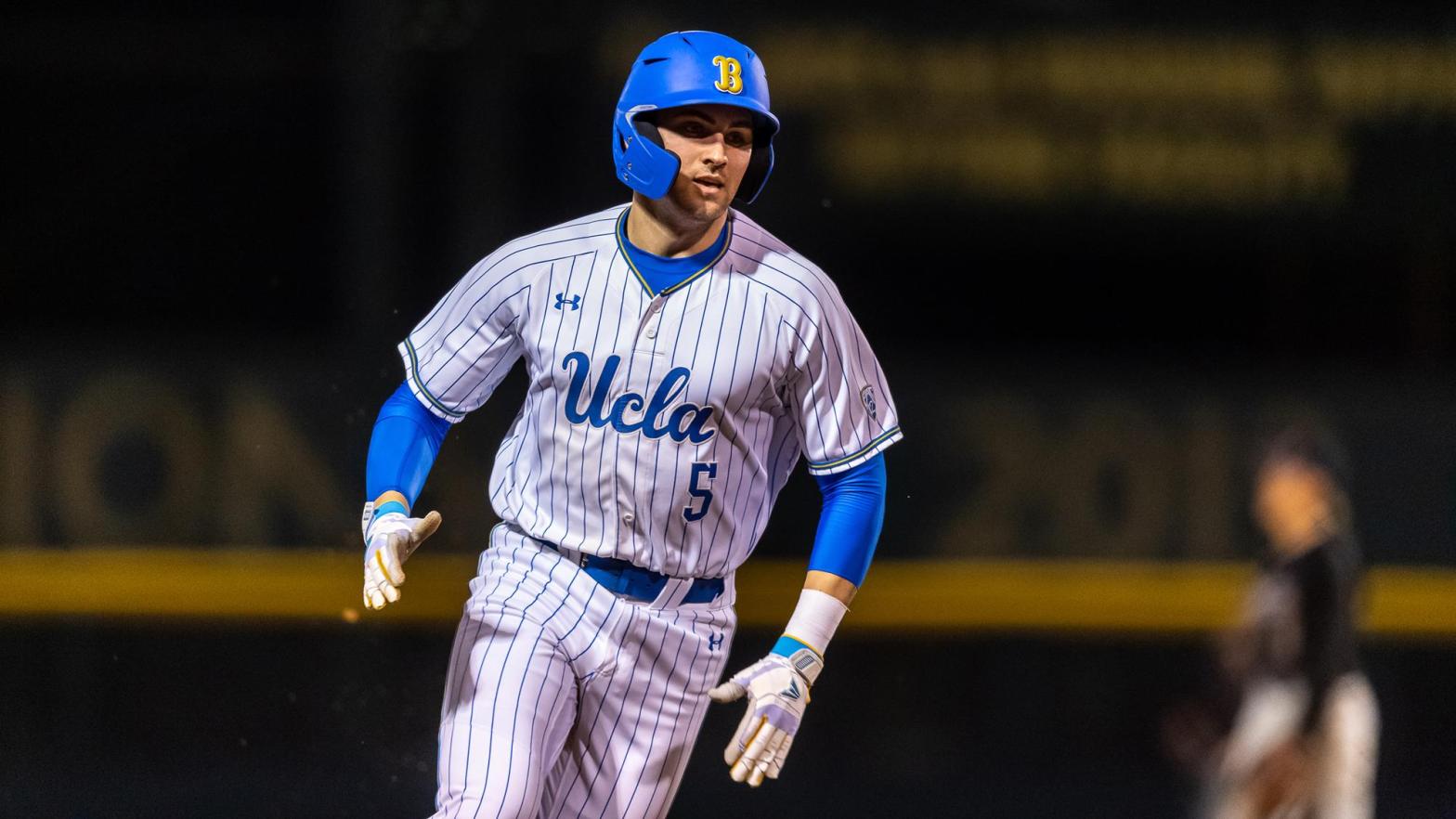
Landing into the lap of the Milwaukee Brewers at 20th overall in the 2020 Major League Baseball Entry Draft, UCLA’s Garrett Mitchell is looking to prove exactly what analysts and fans across the world were thinking: 10 to 15 teams are making a big mistake. As a consensus top 10 player in this draft class, Mitchell was not expected to be available when the Brewers were on the clock at all. Thanks to a draft day slide, however, the Milwaukee faithful can rejoice in the addition of a potential superstar to a thin farm system. Now, let’s dig into why exactly falling so far in the draft was so unbelievable, and the incredible heights a player with these tools may reach.
With a 6’3, 215 lb. frame, this speedy center fielder might have the best tools in the draft. While it is concerning that some his tools are still quite raw after three seasons of college baseball, that still does not properly explain a draft slide this extreme. With that frame and his incredible athleticism, the most likely explanation for his draft side is his health concerns. While he has not experienced any major injuries, his health concerns stem from diabetes, diagnosed in the third grade. Frankly, I don’t think this is an issue. If he still had the ability to develop elite athleticism and show off some of the best tools in the 2020 draft class while managing his diabetes, I am sure that he won’t let it hamper him as he moves up through the minors.
This former Bruin has the raw ability of a 5-tool player, but the biggest difference-maker in whether Mitchell is a solid pro or a bona fide star is his power. The gap between his raw power and his in-game power is wider than that of most players, as evidenced by his bat speed and exit velocity being well above average, but being lost in translation at the plate, with a measly 6 home runs in 543 plate appearances (all coming in his sophomore season). This gap is explained away quite easily by taking a look at Mitchell’s suboptimal mechanics. As a potential top-50 pick out of high school in 2017, Mitchell’s greatest concerns were poor mechanics leading to poor contact and limited game power. As a collegian he cleaned up his swing some, quelling some contact fears, but that swing does still need a lot of work before his power is truly an elite tool. If you watch Mitchell take cuts in games, you’ll notice a swing out in front of his body that he seems to cut short of a complete follow-through, along with irregular rotation that limits the power he can pull from his core and base. That swing is the definition of squandered power potential, though regardless of whether or not those mechanics are fixed, it will be a plus tool due to just how much raw power he carries in that bat. My grade here is taking an optimistic look at the Brewers’ player development staff and hoping they can work out some of the obvious kinks in this motion. Power potential: 60/65.
Thanks to the aforementioned adjustments to his swing throughout his collegiate career, Mitchell went from slashing .280/.337/.331 over the course of his 44 game freshman season to slashing an incredible .355/.425/.484 over an abbrevieated 2020 junior season. As mentioned above, his suboptimal mechanics were doctored to promote contact over power. This is clearly visible in his swing, getting the bat out in front of his body, allowing him to make contact very consistently at the cost of quality. This leads to lots of balls in play, lots of hits, and lots of balls in the gap worth extra bases. Unless his power develops, the extent of his year-to-year offensive value should be determined by his ability to hit for extra bags and batting average on balls in play variability. Hit potential: 60/65.
Garrett Mitchell’s 5-tool designation is largely due to the great defense he showed in college. As a center fielder, one is expected to have more defensive range than any other player on the team. Mitchell had some of the most range of any defender in college baseball. Statcast-designated 5-star catches will be his bread and butter, though there are concerns about his ability to read the ball off the bat quickly. His range will more than make up for that issue and allow him to still be a plus defender, and he does not make a lot of errors, including zero in his sophomore year, his only full season with UCLA. If he can work on his defensive instincts and keep the ball in his glove, he has the chance to put a Rawlings Gold Glove in his trophy case one day. Fielding potential: 65.
One addition to Mitchell’s defensive value is a plus-plus arm tool. Garrett Mitchell has a gun, and he’s not afraid to use it. Though he hits left-handed, he throws with his right, and does an incredible job of it. As an 18-year-old, he logged outfield velocities all the way up to 94 miles per hour, and that has only gone up over the last three years. Expected to reach an outfield velo that pokes into the upper 90’s, he should have one of the strongest arms in the big leagues. Accuracy should not be a big issue either, though right now his accuracy seems to play up to average without some more consistency in his relief point. Without any adjustments, though, his arm should still be a real plus tool. Arm potential: 60.
While every one of his tools is above average and he mixes in some big plus tools, he only has one tool that is truly elite. Mitchell’s speed is an absolute weapon in every conceivable way. In the outfield, it provides him with that incredible range that could make him a Gold Glover. At the plate, it gives him the speed to beat out a lot of infield singles and allows him to turn many singles into doubles, and doubles into triples. With a BABIP of .387, while it should go down, he displays regularly that his speed can help him get to first at a rate higher than that of an equal hitter. 26% of his hits on balls in play were for extra bases, a tick above average, but you can really see the speed in his triples ratio, or the percent of his extra base hits in play are triples. In a college career with an incredible 15 hits for three bags in only 387 balls in play, including 12 in a sophomore season that allowed him to see third base nearly as often he saw second (14 doubles), Mitchell posted a triples ratio of 38.5%. That is so far above average that it can’t be sustainable, but that is what Garrett Mitchell accomplished as a Bruin. Don’t think his speed doesn’t extend to after he’s already on base, though. With 28 steals in 121 games, that is 37 steal pace over a major league, 162 game season. While he won’t get on base as often in the bigs, which is to be expected of any collegiate phenom, which could hamper the ability to steal bases purely due to fewer opportunities, his success rate will continue to impress. With a stolen base rate of 75.7%, including a rate of 81.8% in his sophomore season. While he’ll need to get used to the better catchers found in the professional ranks, his stolen base rate will be sure to impress at every level. Speed grade: 70.
With true 5-tool potential, there is a host of great MLB players to which I could reasonably compare Garrett Mitchell. With the potential to be a 30-30 player, I wanted to find a player with 30-30 pedigree, at least one Gold Glove in center field, and the ability to hit in the .280s or .290s with an OBP that can hang around .350. This kind of player is frankly generational. While I could compare him to Mike Trout, Carlos Beltran, Bobby Bonds, or even Willie Mays, I think it best not to get too lofty with out predictions here, though I do think Mitchell has clear All-Star potential. This leads me to a player with a great prime, five above average tools, and an incredibly underrated career in professional baseball. Pro player comparison: Matt Kemp.
 You Might Know Sports