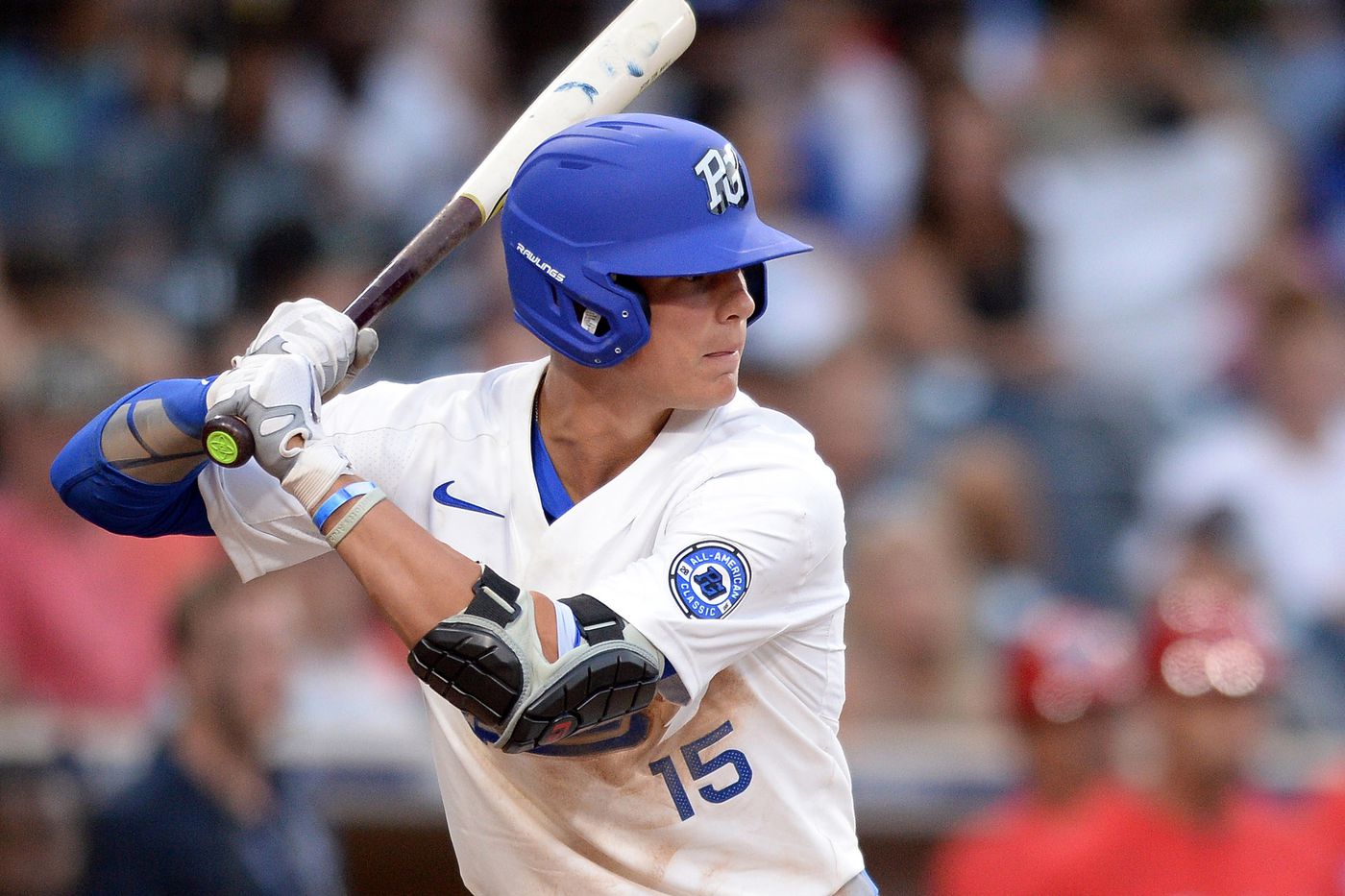
Kansas City Royals fans have not had very much worth watching over the past few seasons. While the blistering speed of Adalberto Mondesi, the resurgent bat of Salvador Perez, and the emergence of Brad Keller have provided the Kansas City faithful with something to tune in for, Royals fans are looking forward to a group of guys that have a chance to take another Commissioners’ Trophy back to the K. The prospect pool in the organization is talent rich, and that includes a few potential franchise cornerstones. The foremost of these upcoming stars is Bobby Witt, Jr., who should hold down the left side of the infield for the Crowns for the foreseeable future.
As the top prep bat in the 2018 MLB Entry Draft, Witt was selected second overall by the Royals to great fanfare. Anointed the heir apparent to the freshly departed Mike Moustakas, Bobby has the versatility and power bat Kansas City counted on in Moose for years. As a true five-tool player, though, Bobby could end up better than the World Series champion he’s set to replace.
His father the third overall pick in 1985 to the Texas Rangers, the Bobby Witts are the highest drafted father-son duo in major league history. With major league pedigree, plenty of raw power, and a great arm, there is plenty of reason to believe that the Royals have one of Major League Baseball’s next stars in Bobby Witt, Jr.
While there were bat to ball concerns at the tail end of his high school career, early in his pro career he is doing a good job of dissuading those doubts. As a right handed hitter, his bat plays up especially well against left handed pitchers. Taking a look at his bat as an amateur, I was most concernced about his bat speed and angle, but the player development staff of Kansas City has done a good job of making that swing more quick and efficient. See the video above for a look at his old swing and the video above to compare for changes. He’s now striding with a purpose, swinging right on the ball instead of too far under it, and swinging that stick faster than ever. While this ball isn’t as deep of a shot, it comes off the bat a lot harder. With his cleaned up mechanics and dominion over the strikezone, there’s little doubt that Bobby Witt, Jr., should be an above average power hitter. While many are still concerned that he will be on the wrong side of average, he hit .359/.405/.462 against younger players and .232/.290/.320 against older players. I believe the age differences in the players he sees will affect him much less as he ages, and those numbers will pick up greatly. Hit potential: 55.
As a minor, Bobby Witt, Jr., was logging regular triple digit exit velocities. As he matures, Witt should become a guy that hits balls harder than almost anyone. His power will only increase as he continues to develop that swing, unlocking more and more power from his lower body and allowing him to really pull the ball deep. If he can consistently land the barrell on the ball, he’ll have no trouble being towards the top of Statcast’s Exit Velocity Leaderboard as a consistent line drive hitter. As a line drive hitter, he should pick up an above average number of doubles, with the bread and butter of his skillset being his 30+ home run a year potential. Power Potential: 60/65.
Bobby is more than just a bat, however. With experience at second, third, and shortstop, he has a chance at providing positive value just about anywhere you put him. While consensus opinion is that his best longterm fit is at third base, the Royals used him at shortstop in all 326 starts he made in the field at rookie ball last season. While there, he displayed impressive mobility, with a wide range in the infield. His glove, however, may leave you wanting more. With 5 errors in 122 chances, Witt ended his first pro season with a fielding percentage of .959. That will certainly need some work before he hits a major league field, but ultimately should not be such a big concern as to move him off the left side of the infield. He also has good instincts on double play balls, turning 17 last season and showing proficiency as both the setup man and the pivot man. Fielding potential: 60.
The reason I believe his longterm fit to be third base is because of an incredible arm. Being logged in the mid-90’s on throws across the diamond, Witt uses his history as a pitcher to his advantage when throwing out first base hustlers. While he needs work speeding up his glove to throwing arm transitions, that will likely be cleaned up by his coaching staff. While his range should lag behind average at short as he fills out his frame guaranteeing his spot on the hot corner, it should be a great arm that keeps him there. Arm Potential: 65.
As I mentioned, Bobby Witt, Jr., is a true five tool player, and that absolutely includes speed. While he’s not quite the burner that his future teammate Mondesi already provides the Royals, Witt should pick up double digit steals year after year, possibly seeing the 20’s if given enough chances. He also uses his speed effectively in the field getting to balls and legging out doubles and triples. On the 7 balls in play that went for extra bases for Bobby in his 180 plate appearances last season with the Arizona Royals, he managed two doubles and an incredible 5 triples to go with his 9 steals. Witt has very legitimate speed, and he should be able to use it as a weapon against major league hitters for the majority of his career. Speed Potential: 60.
Altogether, Bobby Witt, Jr., should be good at just about anything on the diamond. Whether it’s at shortstop or third base, Bobby will be a plus defender at the major league level, especially with an arm that is already amongst the best of all infield prospects and will only get better. His speed should allow him to be amongst the quickest third basemen in Major League Baseball early in his career, and he should remain a good baserunner even as he slows down due to good instincts on the basepaths. In spite of his walk rate likely always being below average and his strikeout rate likely being well above average, Witt should be an above average hitter, getting on base consistently and picking up extra base hits with ease. His calling card as a player, however, will be his ability to park the ball in the outfield seats. As a 40/20 threat with quality infield defense at both third and short, you won’t have to look too far back in order to see a player I’m sure Bobby Witt, Jr., will be emulating the day he hits his first MLB diamond. Pro player comparison: Chipper Jones.

 You Might Know Sports